
Evaluating Private Label Fragrance Suppliers Before You Launch
Private label fragrance looks like the low-risk route into scent: pick from a library, choose a bottle, agree a quantity. The risk has not disappeared, it has moved. Because the product already exists, the supplier's quality is not visible in the scent itself but in how it handles everything around it — the paperwork, the labelling, the reorder, the moment when a library scent is discontinued or reformulated. Evaluating suppliers therefore means evaluating the parts that are not in the catalogue.
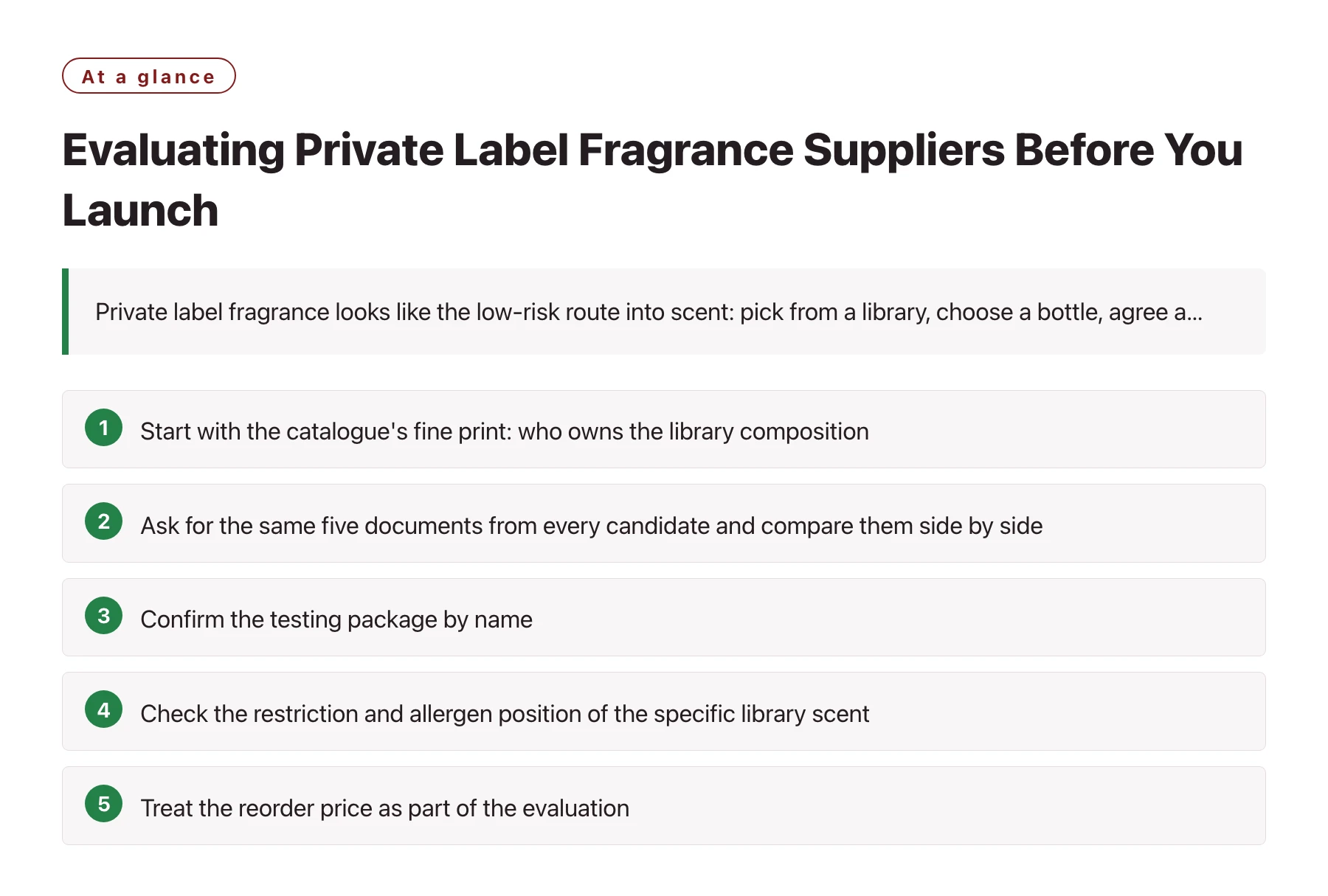
Key takeaways
- Start with the catalogue's fine print: who owns the library composition, how widely it is sold, and what happens if it is withdrawn after your listing goes live.
- Ask for the same five documents from every candidate and compare them side by side, because proposals are written to be attractive while documents are written to be accurate.
- Confirm the testing package by name, including which products and packaging combinations are covered [1].
- Check the restriction and allergen position of the specific library scent, not of the library in general, because limits depend on the category the scent is used in [4].
- Treat the reorder price as part of the evaluation, and ask what can trigger a change in it.
A retailer or creator moving into private label usually runs a short tender: three suppliers, one brief, a requested unit cost at a stated volume. The replies come back within a week and look interchangeable. Each lists a library size, a bottle range, a minimum quantity and a lead time.
The differences that will matter later are not in those numbers. They are in the answers to follow-up questions: how many other brands use the same library scent, whether the label artwork is reviewed by anyone before printing, whether the supplier will confirm the allergen statement in writing, and what a reorder looks like two years later when the original bottle has been discontinued.
The evaluation sequence below is written from the procurement side, with the assumption that the scent is chosen from a library and the brand is responsible for its own label, pricing and channel. That is the common private label shape, and it is also the shape in which supplier weaknesses are least visible at the proposal stage.
A five-step evaluation sequence, in the order that saves the most time
- Fix the brief before contacting anyoneWrite down the category, the format, the volume band, the target shelf life and the markets you intend to sell into. A brief that names only a scent family and a bottle will produce three quotes that cannot be compared.
- Request one document set from all candidates at onceAsk for the composition ownership position, the restriction and allergen statement for the specific library scent, the testing scope, a sample of label artwork review, and a written reorder clause. Same request, same format, same deadline.
- Score the documents, not the pitchGive each candidate a score against the same five criteria and record the gaps. A missing document is information, not necessarily a disqualification; a vague answer to a specific question is a different signal entirely.
- Test the supplier with a small run before a large oneOrder the smallest quantity that exercises the real process: library scent, your bottle or a close equivalent, your label, your carton. This is the only stage where the supplier's coordination is observable rather than described.
- Lock the reorder terms in writingVolume, price validity, lead time and the conditions under which the composition may change. For a private label line this clause matters more than the first order, because a listing that sells out is where the relationship is tested.
The scorecard: five criteria, and what separates a weak answer from a usable one
| Criterion | Weak answer | Usable answer | What to record |
|---|---|---|---|
| Composition ownership | It is our library, you can use it | The library composition is owned by the supplier, you receive non-exclusive use rights for a named territory | Who holds the composition, what rights you hold, and what happens if the composition is retired |
| Exclusivity | Nobody else has it | We can commit to a category or channel restriction for a stated period, and here is the clause | The field, territory and duration of any restriction |
| Compliance documents | We will send what you need | Here is the restriction and allergen statement for this scent, and here is the labelling input file | The documents received, their dates, and who issued them |
| Testing scope | It is tested | These products and packaging combinations are tested under these conditions, commissioned by us or by you | The combinations, the conditions, and the party responsible for repeats |
| Reorder position | Prices stay the same | Price valid for a stated period, minimum reorder quantity stated, changes to be notified in writing | Validity window, minimum quantity, and the notice period for a change |
The pattern in the right-hand column is the same across all five rows: a specific answer names a party, a period or a document. When a supplier gives specific answers to all five, the private label model is doing what it is supposed to do — limiting development risk. That is also the standard worth applying to what a good private label perfume factory looks like when comparing shortlists.
Where private label evaluations usually go wrong
The most common mistake is treating a large catalogue as evidence of capability. A wide library tells you a supplier has invested in formulation variety; it does not tell you how the supplier will handle a labelling question three weeks before a launch. Both are relevant, and only one of them is on the website. A public record of the brands behind these scents is often more informative than a library list, because it shows which categories and channels a factory actually runs rather than which ones it could in principle support.
The second mistake is comparing quotes that cover different scopes. One private label quote may include the bottle, decoration, filling and carton; another may quote the fragrance compound alone. Before comparing totals, mark every line that appears in only one quote — those gaps are the actual comparison.
The third is leaving compliance to the end. Restrictions and labelling requirements are category-specific and expectations differ by market, which is why the trade bodies that follow European cosmetics regulation publish guidance that suppliers are expected to keep up with [2]. A supplier that treats the statement as an afterthought will still produce it, but the timing will land in the middle of your print run.
The library scent that everyone can buy
A library scent is by design available to many brands. That is not a flaw; it is what makes the model affordable. The question is whether the supplier can describe the scale of that availability and whether any restriction is possible. If two competitors in the same channel can be sold the same composition, the scent will not differentiate the product, and the brand's positioning has to come from elsewhere — the format, the packaging, the story.
Retail demand data is a useful input here, since the categories in which own-brand scent grows fastest change from year to year [3]. Choosing a format that is growing is a more reliable hedge than assuming a library scent will be exclusive when it will not be.
What a small first run should prove
A trial run is not a formality before the real order; it is the evaluation. Use the smallest volume that exercises the full path: library scent, actual or near-equivalent bottle, printed label, packed carton, and a delivery date that was promised in writing. If the supplier coordinates that smoothly, the larger order is a question of capacity. If it does not, the problems were always going to appear, and it is much cheaper to find them here. For an influencer launch the trial run does double duty, because it also produces the first honest content: real units, real packaging and a real delivery date to film against.
Testing belongs in this list as well. Stability and compatibility work should be commissioned against named product and packaging combinations, and a laboratory's published cosmetics scope is a reasonable way to check that the described work is the kind of work that can actually be carried out [1].
The single most useful question in a private label tender is also the least glamorous: what will you send me in writing, and when? Suppliers that answer this quickly tend to be the ones whose private label fragrance production runs on a documented process rather than on relationships. The rest of the evaluation becomes much shorter once you know which category a candidate is in.
Sources
- SGS: Cosmetics, Personal Care & Household Testing —— Testing, inspection and certification services for cosmetics and personal care, including microbiological, stability and safety testing aligned with cosmetics GMP.
- Cosmetics Europe —— The European trade association for the cosmetics and personal care industry, publishing guidance, positions and market information.
- Mintel Press Centre —— Mintel's press releases on consumer and beauty market research, including fragrance and personal care trend reporting.
- IFRA Standards Library (International Fragrance Association) —— The IFRA Standards Library lists the restrictions the fragrance industry applies to individual fragrance ingredients, based on safety assessments; it is the reference point for compliant fragrance formulation.
Frequently asked questions
How is private label different from white label fragrance?
The terms are used loosely, but the working distinction is that private label usually means the supplier's composition sold under your brand, while white label often refers to a finished product sold under your brand with minimal scope for changing the scent or the packaging. Both are library-led models, and the ownership and exclusivity questions are the same.
What minimum order quantity should a first private label run expect?
It depends on whether the fragrance, the packaging or the finished unit carries the minimum. A standard bottle with a printed label usually allows a smaller first run than a custom mould or a decorated bottle. Ask for the minimum to be broken down by component rather than quoted as a single figure.
Can a private label scent be modified?
Sometimes. Many suppliers will adjust a library composition at the margins, and some will treat a substantial change as custom development with a different price and timeline. Ask what level of adjustment is included before you assume the library scent is fixed.
What should happen if the supplier discontinues a library scent?
The answer should be in the contract: a notice period, the option to buy remaining stock, and a defined process for selecting and approving a replacement. Without those terms, a discontinuation becomes an urgent sourcing problem while your listing is still live.
Does private label remove the need for testing?
No. It reduces development risk because the composition already exists, but the finished product still needs compatibility and stability work in your packaging and your format, and the documentation still needs to match your labels and the markets you sell into.
Spec'ing a masonry package?
Send drawings, schedule, and scope. We'll return a hard-number bid within 10 business days — no day-labor, no markup layers.
Request a Project Bid